Understanding a Trucker’s License Status After a New York Collision
Key Takeaways: After a serious New York truck crash, a driver’s CDL may be suspended, revoked, or permanently lost depending on the offense. VTL § 510-a mandates revocation for felonies, hit-and-runs, driving while disqualified, or causing a fatality. A first revocation lasts at least one year, rises to three years for hazardous materials, and becomes permanent for repeat offenders. Chemical test refusals trigger administrative penalties. While a CDL covers only commercial driving, losing the license typically leads to job termination. Repeated serious traffic violations bring escalating suspensions, and the DMV can deny renewal of a general (non-commercial) driver’s license to "problem drivers." These administrative penalties are separate from civil lawsuits, yet a driver’s CDL history serves as powerful evidence of negligence against both driver and employer. Injured victims should act quickly to preserve evidence and meet civil deadlines.
A truck driver’s commercial driving privilege can change dramatically after a serious crash on a New York road. Depending on the circumstances, a commercial driver’s license may be suspended, revoked, or permanently lost, and employment often ends as well. For injured victims and families, understanding these consequences helps explain liability and accountability after a collision.
For people hurt in a commercial truck wreck, the at-fault driver’s CDL status is more than a technicality. It can reveal dangerous driving patterns, prior violations, or regulatory failures that strengthen a negligence claim. If you were injured by a commercial truck in the Five Boroughs, the team at Pianko Law is ready to help; call us at (646) 801-9675 or reach out through our secure contact page to discuss your options.
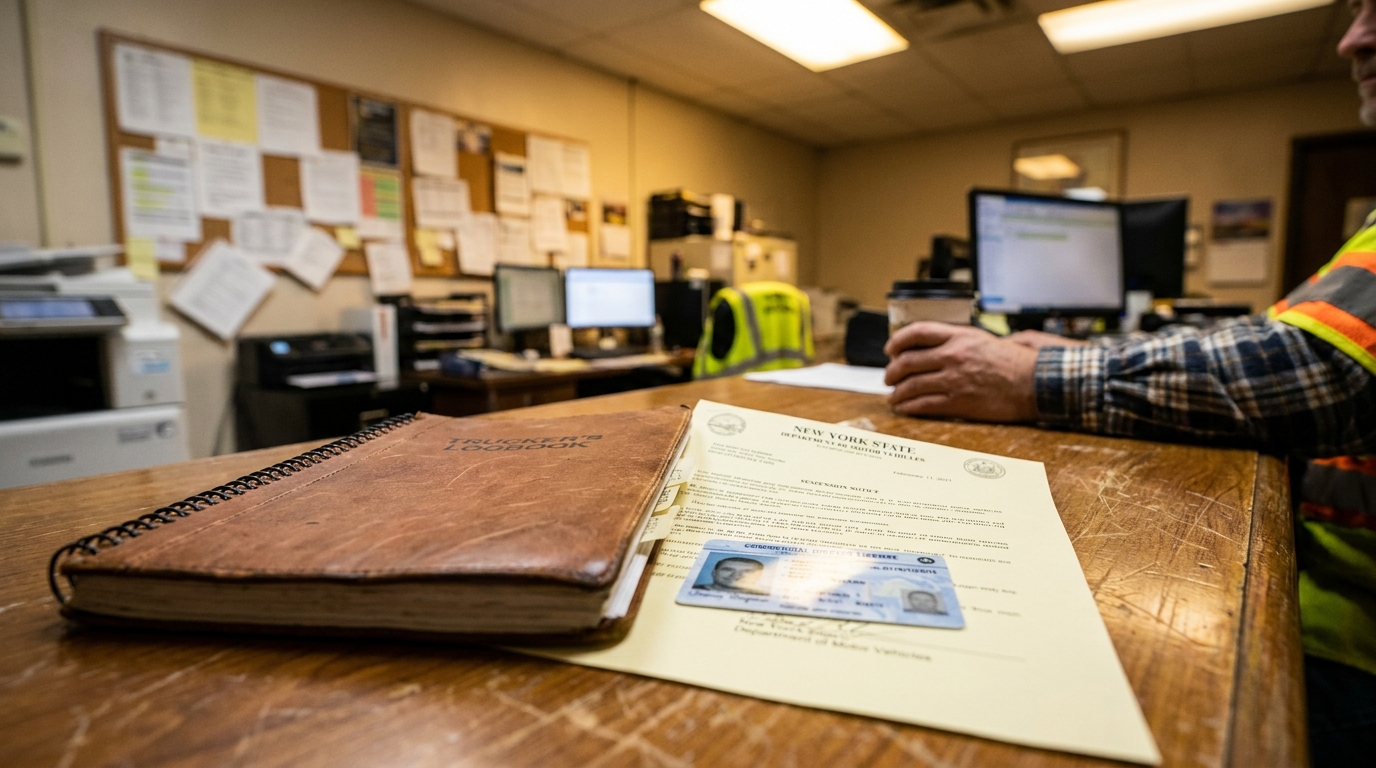
How New York Law Governs CDL Suspension and Revocation
New York Vehicle & Traffic Law § 510-a controls when a commercial driver’s license must be suspended or revoked. This statute incorporates federal disqualification standards under 49 CFR § 383.51 for major offenses, serious traffic violations, and railroad-crossing violations, creating a layered system of state and federal rules.
The statute distinguishes between commercial and non-commercial driving privileges. Under VTL § 510-a, Subdivision 5, any revocation or suspension applies only to commercial motor vehicle operation, and the commissioner must issue a regular license if the person is otherwise eligible. A trucker who loses a CDL after a crash may still drive a personal vehicle, subject to other restrictions. You can review the full text through the New York State Senate’s posting of Vehicle and Traffic Law § 510-a.
💡 Pro Tip: If you were injured, ask your attorney to obtain the driver’s certified abstract early. A driver’s history of suspensions or disqualifications can be powerful evidence of negligence.
Do Truck Drivers Get Fired for Accidents in New York?
Whether truck drivers get fired for accidents depends on the circumstances of the crash. Employment decisions belong to the trucking company, but a driver who loses commercial driving privileges generally cannot keep a job requiring a valid CDL. When a license is suspended or revoked, termination often follows as a practical consequence.
This also connects to unemployment eligibility. In one reported case from Massachusetts (not New York), a claimant who refused a breathalyzer had his license revoked and was fired, and the Board held he voluntarily caused his discharge, supporting denial of unemployment benefits. In New York, refusing a chemical test under VTL § 1194 results in license suspension at arraignment followed by a DMV refusal hearing, not a purely automatic revocation, and it can similarly lead to job loss for CDL holders, but the specific case described has not been confirmed as a New York decision.
The question oversimplifies a fact-dependent issue. A minor incident with no violation may have little employment effect, while a fatal or alcohol-related crash frequently ends a commercial driving career. Outcomes vary by the offense nature, the driver’s record, and company policy.
Major Offenses That Trigger CDL Revocation After a Crash
Certain serious offenses require mandatory CDL revocation under New York law, leaving the commissioner no discretion. Under VTL § 510-a, Subdivision 1, a commercial driver’s license shall be revoked for: conviction of a felony involving a motor vehicle, leaving the scene under VTL § 600, operating while disqualified, or causing a fatality through negligent operation of a commercial motor vehicle, including vehicular manslaughter or criminally negligent homicide. These categories often overlap with catastrophic truck crashes that injure or kill others.
Revocation length depends heavily on the driver’s prior record and cargo. For a first mandatory revocation, no new CDL may be issued for at least one year, but prior DWI convictions, chemical test refusals, or other specified offenses trigger permanent revocation under VTL § 510-a, Subdivision 2(a). Where the vehicle was transporting hazardous materials, the minimum period increases to three years under Subdivision 2(b), with permanent revocation for repeat offenders.
Even permanent revocation is not always absolute. Under VTL § 510-a, Subdivision 2(c), permanent CDL revocation may be waived after ten years if the driver maintains a clean record, completes required rehabilitation, and obtains a certificate of relief from disabilities. Courts and the DMV apply these conditions strictly, so reinstatement is far from guaranteed.
💡 Pro Tip: Refusing a breathalyzer does not protect a commercial driver. A CDL holder who refuses a chemical test after a DWI arrest faces immediate administrative suspension at arraignment and strong administrative penalties that can lead to revocation even if criminal charges are later dismissed.
Chemical Test Refusals and Automatic Penalties
Refusing a chemical or breathalyzer test after a DWI arrest carries especially harsh consequences for commercial drivers. In one New York matter, a driver’s CDL was revoked based on his refusal to submit to a chemical test following a DWI arrest, and the court affirmed the suspension. For victims, evidence of a refusal can signal impairment and support claims of reckless or negligent conduct.
Serious Traffic Violations and the CDL Points System
Not every truck crash involves a felony, but repeated serious traffic violations still carry escalating penalties. Under VTL § 510-a, Subdivisions 3 and 4, two serious traffic violations arising from separate incidents within three years result in a 60-day CDL suspension, and three within three years result in a 120-day suspension.
Serious traffic violations include a defined set of dangerous behaviors directly tied to crash risk: speeding 15 or more miles per hour over the limit, reckless driving, improper or erratic lane changes, following too closely, and any traffic violation arising from a fatal accident.
Driving conditions also matter when evaluating violations. In one New York case, a truck driver’s suspension was upheld where he drove 50 to 55 miles per hour in wet, rainy, dark conditions and struck a disabled vehicle, killing one person and injuring another. The court found substantial evidence he violated the rule against driving faster than was reasonable under the conditions, showing speed limits are not the only measure of unsafe driving.
When the DMV Labels a Driver a "Problem Driver"
New York regulators can deny renewal of a general (Class D) driver’s license to drivers with troubling histories, even without a single disqualifying felony. However, the "problem driver" restriction cannot be applied to a CDL (Class A, B, or C); CDL holders face separate disqualification standards under VTL § 510-a and federal regulations. In a 2020 case, a driver’s CDL was suspended after conviction under VTL § 1146(c)(1) following a fatal pedestrian collision, and the DMV later denied renewal of his general (Class D) driver’s license because it classified him as a "problem driver" under 15 NYCRR § 136.1(b)(1). This administrative determination can reveal a documented pattern of dangerous driving.
No Hiding the Record
New York law prohibits "masking" CDL-related convictions, consistent with federal requirements. Under 49 CFR § 384.226, a federal regulation with which New York must comply, courts and the State generally cannot hide or reduce CDL-related convictions through plea arrangements, diversion programs, or deferred judgments; the New York DMV has issued guidance to courts and prosecutors reinforcing this anti-masking requirement. For victims, this transparency means a commercial driver’s serious offenses remain visible and discoverable.
Why CDL Consequences Matter to Injured Victims
Administrative penalties a trucker faces are separate from any civil claim an injured person may bring. A CDL suspension or revocation is handled by the DMV and does not compensate a victim for medical bills, lost wages, or pain and suffering. To recover damages, an injured claimant must prove negligence by a preponderance of the evidence, often through police reports, medical records, and event data recorder information.
Evidence of license and qualification problems can strengthen a negligence case against both driver and employer. Under respondeat superior, a trucking company may be liable for driver negligence within the scope of employment, and proof that a driver lacked proper credentials can support claims of negligent hiring or supervision. Related issues, such as CDL medical certificate rules, can also reveal whether a carrier ignored safety obligations.
💡 Pro Tip: Electronic data fades fast. Ask your attorney to send a preservation letter quickly so the truck’s event data recorder and the carrier’s records are not overwritten or lost.
Timing is critical because civil claims are governed by their own deadlines, not by the DMV’s process. New York’s civil statutes of limitations apply to personal injury and wrongful death claims. The state court system publishes a helpful overview through its statute of limitations timetable, though deadlines are fact-specific and should be confirmed with an attorney. If you need guidance on a New York truck accident CDL impact matter, prompt legal review helps protect your rights.
Frequently Asked Questions
-
Does a truck driver automatically lose a CDL after every crash?
No, not every crash triggers automatic license loss. Mandatory revocation generally applies to specific offenses under VTL § 510-a, such as felonies involving a vehicle or causing a fatality, while lesser incidents may result in points or suspensions.
-
How long does a CDL revocation last in New York?
The duration depends on the offense and driver’s history. A first mandatory revocation generally lasts at least one year, increases to three years for hazardous materials cases, and may become permanent for repeat offenders.
-
Can a driver still drive a personal car after a CDL revocation?
Often yes, because the penalty applies only to the commercial privilege. Under VTL § 510-a, Subdivision 5, the commissioner must issue a regular license if the person is otherwise eligible.
-
How does the driver’s CDL status help my injury claim?
It serves as evidence of negligence or unfitness. A record of suspensions, refusals, or a "problem driver" designation may support claims against the driver and employer.
-
Is the DMV penalty the same as my lawsuit?
No, the two processes are entirely separate. A DMV revocation addresses driving privileges, while a civil lawsuit seeks compensation for your injuries and losses.
Protecting Your Rights After a Serious Truck Crash
A commercial driver’s license status after a crash reflects New York’s commitment to highway safety. From mandatory revocations for fatal collisions to escalating suspensions for repeated violations, the rules under VTL § 510-a create real consequences for dangerous truckers. For injured victims, these rules often uncover the evidence needed to prove fault and pursue fair compensation.
If a commercial truck collision upended your life, you do not have to navigate the aftermath alone. Pianko Law is trusted by injured New Yorkers for handling complex truck crash claims with care. Contact Pianko Law today by calling (646) 801-9675 or using our confidential case review form to learn how we can help you move forward.