The Hidden Witness Inside Your Car After a Crash
Key Takeaways: An event data recorder is a small crash-triggered module in most modern vehicles that stores a few seconds of technical information such as speed, braking, throttle position, seat belt use, and airbag deployment. Federal rules don’t require automakers to install EDRs, but they standardize what the devices must capture in vehicles manufactured for the 2013 model year forward, so most cars in a New York City crash likely recorded something. This matters because New York uses pure comparative negligence under CPLR § 1411, where fault percentage reduces recovery rather than barring it. New York courts and proposed legislation generally treat recorded data as belonging to the vehicle’s owner, so access usually requires consent, a court order, or another legal basis, and retrieval demands specialized equipment and interpretation. Timing is critical, since salvaged or repaired vehicles can permanently erase the record. The data is powerful but limited, it can’t show distraction, intoxication, or road conditions, and outcomes always depend on case-specific facts.
An event data recorder is a small electronic module built into most modern vehicles that captures technical information in the seconds surrounding a collision, including speed, brake application, throttle position, seat belt use, and airbag deployment. In a New York City car accident case, that recording can function as a neutral witness when drivers tell conflicting stories. Because it records numbers rather than opinions, this vehicle crash data recorder can become one of the most persuasive pieces of proof in a serious injury claim, though its weight always depends on how it’s retrieved, authenticated, and explained.
If you were hurt in a collision in the Bronx, Brooklyn, or Queens, the data inside the vehicles involved may not survive long. Pianko Law helps injured New Yorkers move quickly to preserve crash evidence. Call (646) 801-9675 or contact us now to discuss your situation.
An EDR Definition in Plain English for Injured New Yorkers
An event data recorder, commonly called a vehicle black box, is generally a crash-triggered memory device rather than a continuous surveillance system. It typically holds only a few seconds of information from just before, during, and after an event like airbag deployment or hard braking, often the period most disputed in a NYC car accident.
Most vehicles on New York roads today contain one. Federal regulation through NHTSA, codified at 49 C.F.R. Part 563, doesn’t mandate EDR installation but standardizes the data elements an EDR must capture when equipped, applying to vehicles manufactured on or after September 1, 2012 (2013 model year). Because most manufacturers install them voluntarily, odds are strong that the vehicle in your crash recorded something. Commercial vehicles often carry additional telematics that may capture even more.
The information generally falls into a handful of categories, depending on make, model, and impact severity:
- Pre-crash vehicle speed and engine throttle position
- Brake application and, in some vehicles, steering input
- Seat belt buckle status for front occupants
- Airbag deployment timing and change in velocity (delta-V)
- Whether the driver attempted evasive action before impact
Why Event Data Recorder Car Accident Evidence Matters in a New York Injury Case
This evidence matters because New York applies a pure comparative negligence standard. Under CPLR § 1411, a plaintiff’s own culpable conduct generally doesn’t bar recovery; damages are instead diminished in proportion to that conduct. A partly responsible plaintiff may still recover, but the assigned percentage can matter enormously to the final award.
That percentage is often where cases are won or lost. When an insurer argues you were speeding or failed to brake, downloaded crash data may support or contradict that theory with timestamps and numbers. Courts may weigh such technical proof alongside police reports, surveillance footage, and witness testimony, though admissibility is decided case by case.
Strong technical proof may also shape negotiations. CPLR § 5047 confirms parties retain broad discretion to settle claims. In practice, credible accident reconstruction data can narrow the factual disputes that keep cases from resolving.
How Reconstruction Professionals Read the Data
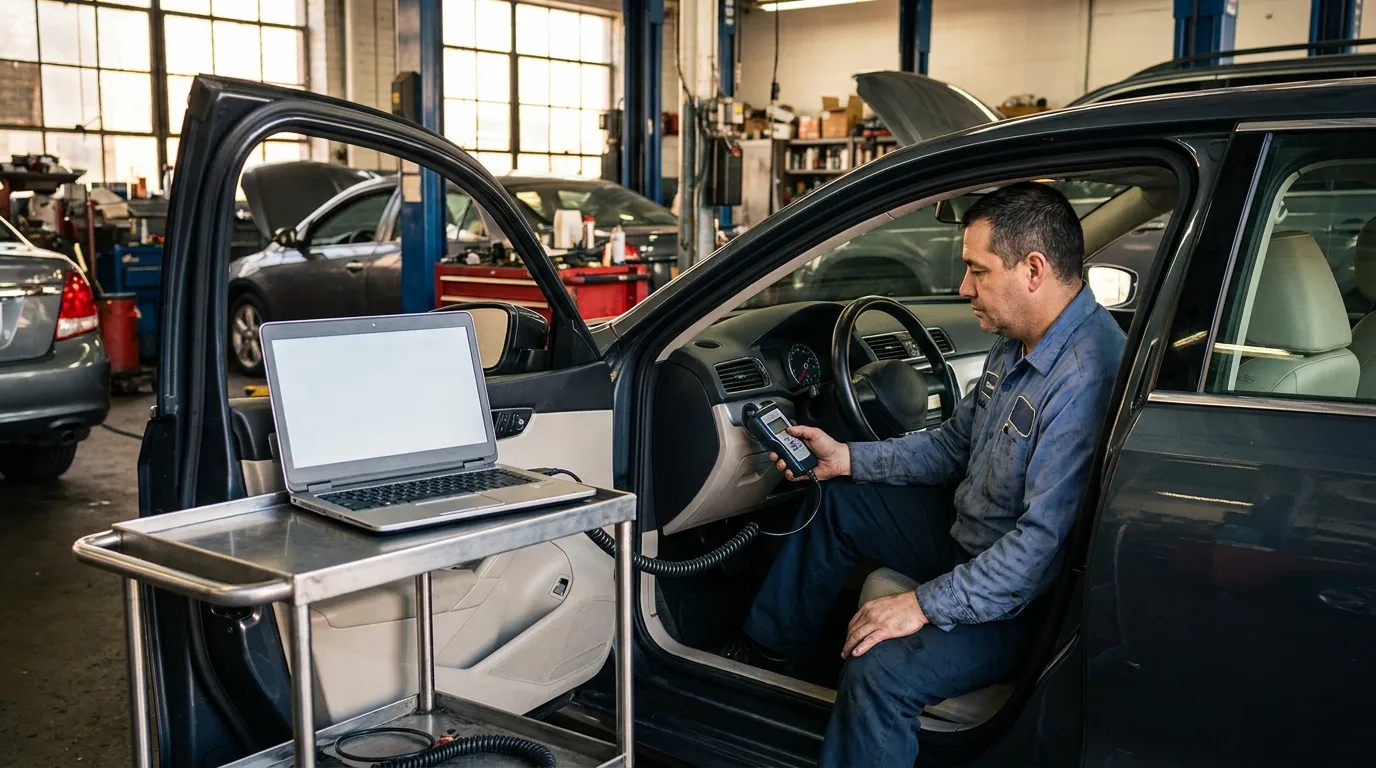
Downloading an EDR isn’t like plugging in a phone charger. Accessing the module typically requires dedicated hardware and software, such as the Bosch Crash Data Retrieval system, plus training in manufacturer-specific formats. An improper download attempt can corrupt or overwrite the record you need.
Interpretation matters as much as extraction. A reconstruction professional generally compares recorded values against physical evidence, crush damage, skid marks, roadway geometry, to assess consistency. Where numbers conflict with the physical scene, that discrepancy itself may become contested at trial.
Who Owns the Data, and How Lawyers Obtain It
EDR information is generally treated as belonging to the vehicle’s owner, not the manufacturer or an insurer. New York hasn’t enacted a comprehensive EDR ownership statute, but proposed legislation (Assembly Bill A03737) would have framed recorded data as owner property, generally requiring consent, a court order, or another legal exception for third-party access. Federal law, 49 U.S.C. § 30102 note, similarly treats EDR data as owner or lessee property and limits retrieval absent consent or court order. That’s why a claimant usually can’t simply demand a download from the other driver.
In litigation, the practical path often runs through discovery. A plaintiff’s attorney may serve a preservation letter, then move under CPLR Article 31 for a court-supervised inspection allowing extraction of the module’s contents. Where a vehicle is scheduled for salvage or repair, an expedited application may be appropriate, though courts decide based on the specific showing made.
Authentication is a separate hurdle from access. Legal scholarship, including analysis in the Buffalo Law Review on black box evidence, examines how courts evaluate ownership, discoverability, and reliability. New York’s caution elsewhere is comparable: CPL § 245.20(1)(s) requires disclosure of calibration, certification, inspection, repair, and maintenance records for machines and instruments used in scientific tests such as breath, blood, urine, or saliva analysis, but only in prosecutions alleging a violation of the Vehicle and Traffic Law. That rule doesn’t govern civil cases, but a party offering crash data civilly should generally be prepared to show the retrieval process and chain of custody were sound.
| Evidence Source | What It Typically Shows | Common Limitation |
|---|---|---|
| Event data recorder | Speed, braking, belt use, delta-V | Very short recording window |
| Police accident report | Officer observations, statements | Often hearsay-limited at trial |
| Traffic or business camera | Visual sequence of the collision | Footage overwritten quickly |
| Medical records | Injury type, causation, treatment | Does not address fault |
💡 Pro Tip: Photograph the other vehicle’s year, make, model, and VIN at the scene if you safely can. That helps counsel determine whether the vehicle likely carries a recoverable module.
Timing Pressures That Can Quietly Erase Crash Data
EDR memory is finite, and vehicles don’t sit still after a collision. Insurers frequently declare a total loss and send the car to auction or salvage within weeks. Once the module is scrapped or the vehicle repaired, the record may be gone permanently, and a court order generally can’t recreate it.
Separately, statutory deadlines govern the claim itself. Most personal injury negligence actions carry a three-year limitations period under CPLR § 214(5), while claims against a public entity generally require a notice of claim within 90 days under General Municipal Law § 50-e and suit within one year and 90 days. These are distinct tracks with different clocks, and missing either can end a case regardless of how strong the technical proof is.
Discovery-based timing rules exist, but they’re narrow. Under CPLR § 203(g), where a limitations period is computed from discovery of facts, the action must generally be commenced within two years of discovery or the otherwise applicable period, whichever is longer. This applies only where a specific statute makes discovery the trigger; ordinary motor vehicle claims accrue on the crash date, so no one should assume later-discovered crash data extends a deadline. Whether an exception applies is fact-dependent and should be evaluated by counsel promptly.
Practical Steps After a Serious Collision
What you do in the first weeks often determines what evidence still exists later:
- Seek medical care immediately and follow the treatment plan
- Photograph both vehicles, the roadway, and any traffic control devices
- Write down the responding precinct and the accident report number
- Avoid giving a recorded statement to the other insurer before consulting counsel
- Ask an attorney about sending a spoliation and preservation letter right away
💡 Pro Tip: If your own vehicle was damaged, don’t authorize repairs or release it to the insurer until your attorney confirms whether its module should be downloaded first. Your own data may corroborate your account.
Limits Worth Understanding Before You Rely on the Black Box
Recorded data is powerful, but not automatically admissible or correct. A court may exclude or limit the evidence if retrieval, chain of custody, or interpretation is inadequately supported. Opposing counsel may challenge speed readings on vehicles with non-standard tires or prior repairs.
The device also has blind spots. It generally doesn’t record texting, intoxication, fatigue, road conditions, or the conduct of pedestrians and cyclists. For those issues, phone records, toxicology, and witness testimony are often essential. Reading more car accident evidence guides can help you understand how these proof sources fit together.
Finally, outcomes depend on facts that vary case by case. Nothing about EDR practice guarantees a particular result; two crashes with similar downloads can resolve very differently based on injuries, insurance limits, and liability disputes. A lawyer experienced in handling event data recorder car accident evidence can assess what your specific data may or may not establish.
Frequently Asked Questions
1. Does every car in New York City have an event data recorder?
Not every vehicle, but most do. Federal standards don’t require EDRs, yet they govern what devices must record in model year 2013 and later vehicles that have them, and many earlier models also contained manufacturer-specific modules. Older cars, most motorcycles, and certain imported vehicles may lack recoverable data.
2. Can the other driver refuse to let me access their black box data?
Often, yes, at least initially. Federal law and New York practice treat the data as the vehicle owner’s property, so access generally requires consent, a court order, or another recognized legal basis. In litigation, a court may order production or a supervised inspection upon an appropriate showing.
3. How long does crash data survive after an accident?
It varies. Some modules retain data until overwritten by a subsequent event, while others can be cleared during repairs or lost when a vehicle is salvaged. Because total-loss vehicles are often disposed of within weeks, prompt preservation requests are important.
4. Will black box evidence prove the other driver was entirely at fault?
It may support your position, but rarely resolves fault by itself. Under New York’s pure comparative fault framework, a factfinder weighs all evidence and may assign percentages to more than one party. Recorded speed and braking data typically work alongside photographs, testimony, and reconstruction analysis.
5. What if my own data shows I was partially responsible?
You may still be able to recover. New York doesn’t bar recovery for partially at-fault plaintiffs; damages are instead reduced in proportion to the plaintiff’s share of fault under CPLR § 1411. An honest early assessment of unfavorable data lets counsel plan around it rather than be surprised by it.
Turning Technical Data Into a Stronger Claim
Event data recorders have quietly become one of the most important sources of car accident evidence in New York injury cases, potentially offering objective detail about speed, braking, and restraint use during the moments that matter most. That value depends on preservation, proper retrieval, and careful interpretation, none of which happen automatically. Because New York reduces rather than eliminates recovery for comparative fault, the precision crash data provides may meaningfully affect what an injured person recovers, though every outcome turns on its own facts.
If a serious collision has left you facing medical bills and an insurer questioning your account, act before the evidence disappears. The team at Pianko Law can evaluate whether a vehicle black box download may help your claim. Call (646) 801-9675 or reach out for a case review today.
Disclaimer: This content is for informational purposes only and is not legal advice. Every case is unique, and results may vary. Consult an attorney about your specific circumstances.