The Stairway Rulebook That Could Decide Your NYC Injury Claim
Key Takeaways: NYC Administrative Code § 27-375 sets measurable requirements for interior stairs including minimum widths, riser and tread proportions, landings, headroom, guards, handrails, and door swing. For interior stair fall victims, departure from these standards may serve as objective evidence of breach of duty. In New York, municipal code violations are treated as evidence of negligence rather than negligence per se. Violations alone don’t decide cases because causation, damages, notice, and comparative fault remain contested. Missing, loose, or poorly positioned handrails and uneven risers are common defects. Because stairways are often repaired quickly, early photographs, witness information, video preservation requests, and professional measurements are critical. Deadlines matter, especially for falls in NYCHA or other public buildings requiring a Notice of Claim and shortened filing window.
If you fell on an interior stairway in a New York City building, the dimensions of those stairs may matter as much as what caused your fall. NYC Administrative Code § 27-375 sets detailed requirements for interior stairs, covering width, handrails, riser and tread proportions, landings, headroom, and door swing. When stairs fall short of those standards, that shortfall may become useful evidence in a premises liability claim.
Pianko Law represents injured people across the Bronx, Brooklyn, Queens, and Manhattan who were hurt on unsafe stairways. Call (646) 801-9675 or contact us now to discuss your situation.
What NYC Building Code 27-375 Interior Stairs Rules Actually Require
Section 27-375 is a construction and egress standard within Title 27, Subchapter 6 of the 1968 NYC Building Code. It governs means of egress and is enforced by the Department of Buildings. Buildings constructed or altered after 2008 are generally governed by the newer code, so identifying which code edition applies is an early step.
The section addresses several distinct hazards that appear repeatedly in stair-fall cases. Each subsection creates a measurable requirement. The following overview summarizes core provisions of the interior stairs building code, and the full text controls in any given case.
| Provision | Requirement |
|---|---|
| Width (27-375(b)) | Interior stairs shall be at least 44 inches wide, with 36 inches allowed where a stair serves not more than 30 occupants per stair on any floor in buildings classified in occupancy groups J-1 and J-2, or when serving buildings classified in occupancy group J-3 and exceeding four stories in height, or when serving not more than 60 occupants per stair on any floor in buildings classified in occupancy groups E, B, and D |
| Measurement | Width is the clear width between walls, grilles, guards, or newel posts, with stringers projecting no more than two inches per side; no interior stair may be reduced in width in the direction of exit travel |
| Risers and treads | Must comply with table 6-4, and the sum of two risers plus one tread exclusive of nosing shall be not less than 24 nor more than 25.5 inches |
| Landings (27-375(d)) | Landings and platforms shall be provided at the head and foot of each flight of stairs, with minimum widths measured perpendicular to travel |
| Guards and handrails (27-375(f)) | Stairs shall have walls, grilles, or guards at the sides and handrails on both sides, except stairs less than 44 inches wide may have a handrail on one side only |
| Handrail detail | Handrails shall provide a finger clearance of 1.5 inches and shall project not more than 3.5 inches into the required stair width; intermediate handrails are required for stairs more than 88 inches wide |
| Door swing | The swing of stair doors shall not block stairs or stair landings, nor reduce effective landing or stair width below 75 percent of the required width |
Why Handrails Draw So Much Attention
Missing, loose, or badly positioned handrails are frequently cited stair code violations in NYC injury cases. A person who begins to lose balance either catches something solid or does not. Under § 27-375, handrails must provide finger clearance of one and one-half inches and may not project more than three and one-half inches into required stair width, and stairs wider than eighty-eight inches generally require intermediate handrails.
The handrail issue often turns on details a victim never notices in the moment. A rail mounted flush against the wall with no finger clearance can be difficult to grip. A rail that ends early, wobbles at the bracket, or was removed during renovation can be documented with photographs and measurements taken soon after a fall.
Riser, Tread, and Width Problems Cause Missteps
Uneven or non-conforming steps are a recurring cause of interior stairway injury because the body walks a staircase from memory. Section 27-375 ties riser and tread dimensions to table 6-4 and a fixed mathematical relationship, providing an objective standard. A single riser that differs noticeably from others in a flight may interrupt a person’s gait.
Width violations matter for a different reason. Sub-code-width or obstructed stairs can concentrate foot traffic, and the code prohibits narrowing an interior stair in the direction of exit travel. Where a fall involves crowding, a propped door, or stored items, the door-swing and clear-width provisions may become directly relevant.
How a Stair Code Violation Fits Into a Negligence Case
A code violation does not automatically win a case, but may substantially strengthen one. Negligence generally means failure to behave with the level of care that a reasonable person would have exercised under the same circumstances. Cornell’s overview of negligence elements identifies the components a plaintiff must establish: duty, breach, harm, and causation.
Where a defendant violates a safety statute without excuse, courts may apply negligence per se. Under that doctrine, the violation itself may establish breach of duty, provided the injured person falls within the class the provision was designed to protect and the harm is of the type meant to be prevented. New York courts generally distinguish between state statutes, whose unexcused violation can constitute negligence per se, and local ordinances or administrative code provisions such as § 27-375, whose violation is treated as evidence of negligence for the jury to weigh.
Notice often remains a central battleground even when a code problem exists. Property owners commonly argue they lacked actual or constructive knowledge of a defect, or that the injured person was comparatively at fault. Under New York’s pure comparative fault rule, a plaintiff’s share of responsibility reduces rather than eliminates recovery.
💡 Pro Tip: A building’s Department of Buildings record may reveal prior complaints, violations, or permit history for the same stairway, which may help address the notice question.
Documenting an Interior Stairway Injury Before Evidence Disappears
Stairways are often repaired quickly after someone falls, making early documentation critical. A missing handrail installed the week after your accident may be difficult to prove later. If you are physically able, or if a family member can help, these steps preserve crucial evidence:
- Photograph the full flight, handrail (or absence), landing, and lighting conditions with an object for scale
- Note the building address, floor, and which stairwell
- Identify witnesses, building staff, and anyone who prepared an incident report
- Request preservation of security camera footage in writing immediately, as systems often overwrite within days
- Seek medical evaluation promptly, including for head, neck, and back symptoms
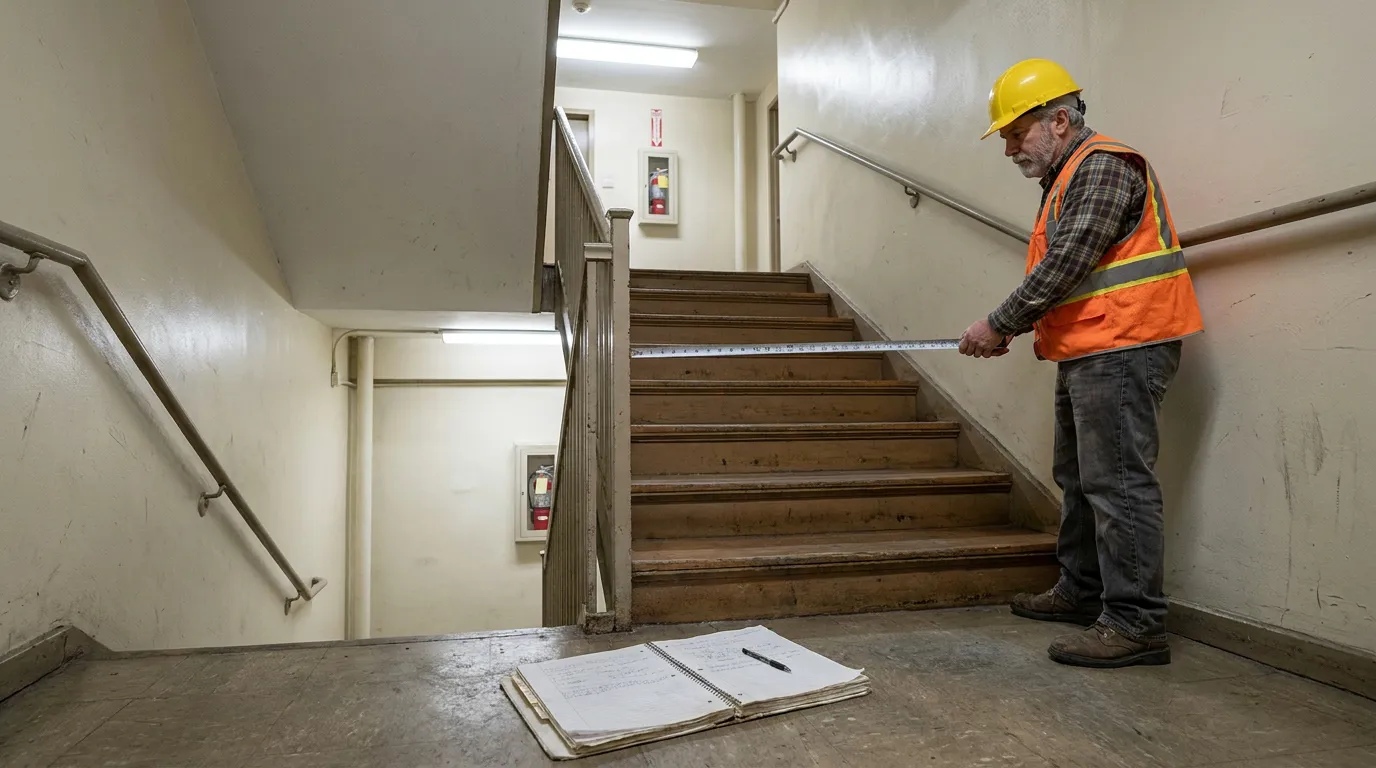
Measurements taken by a qualified professional generally carry more weight than a victim’s estimates. Attorneys handling these matters often retain engineers to measure risers, treads, clear widths, and handrail geometry against the applicable code. That analysis can be difficult to reconstruct once a landlord rebuilds the stairs.
Sidewalk Falls Follow a Different Rule
Not every NYC fall is governed by the same provision. Falls on exterior sidewalks are analyzed under a separate maintenance-liability provision, which our discussion of NYC Admin Code 7-210 duties explains in detail.
Deadlines That Can End a Claim Before It Starts
New York civil statutes of limitations vary widely, and verifying the applicable deadline early is important. Most personal injury claims against private defendants are subject to a three-year period counted from the date of the event.
Government-owned property can change the timeline significantly. If your fall occurred in a NYCHA building or another public property, a Notice of Claim is generally required within 90 days, and the statute of limitations may be as short as one year and 90 days. Missing either can be fatal to a case.
Tolling and delayed-accrual arguments exist but courts interpret them narrowly. Exceptions may apply in limited circumstances involving minors, incapacity, or a defendant’s absence from the state, but they don’t apply automatically.
Frequently Asked Questions
1. Does a stair code violation guarantee I win my case?
No. A violation may support a breach-of-duty argument and is generally admissible as evidence of negligence, but you must still prove causation and damages. Owners frequently dispute whether the violation caused the fall.
2. What if I did not notice the handrail was missing until afterward?
That is common and does not bar a claim. What matters is whether the condition violated applicable standards and contributed to your injury, though comparative fault arguments may be raised.
3. Do these rules apply to older buildings?
Application depends on when the building was constructed or altered. Section 27-375 generally governs buildings built or altered under the 1968 code, while newer construction is governed by later versions.
4. My symptoms appeared days later. Is it too late to act?
Delayed head, neck, and back symptoms are well recognized after stair falls. Prompt medical evaluation and legal consultation are advisable, because the filing deadline usually runs from the date of the fall rather than when symptoms appear.
5. What if the fall happened in a NYCHA building?
Claims involving public entities generally require a Notice of Claim and a shortened filing window. These deadlines arrive quickly, so early action matters.
Turning Code Requirements Into Real Answers
Section 27-375 offers interior stair fall victims something relatively rare in premises liability: a written, measurable standard for what a safe stairway in New York City should look like. Width, riser and tread proportions, landings, headroom, guards, handrails, and door swing are each addressed, and a departure from any may support a negligence argument. Outcomes depend on specific facts, which code edition applies, proving causation, and meeting the applicable deadline. A knowledgeable stair injury attorney NYC can evaluate whether the stairway that injured you actually complied.
If a stairway defect left you hurt, the team at Pianko Law is ready to review what happened and explain your options. Call (646) 801-9675 or request a case review today.
Disclaimer: This content is for informational purposes only and is not legal advice. Every case is unique, and results may vary. Consult an attorney about your specific circumstances.