When a Small Sidewalk Crack Becomes a Big Legal Fight
Key Takeaways: The trivial defect doctrine is a defense New York property owners use to argue that a condition causing a fall was too slight to be legally actionable. New York courts reject bright-line minimum measurements and instead weigh the defect’s width, depth, elevation, and irregularity alongside the time, place, lighting, and circumstances of the fall. A small defect may still be actionable if it functions as a trap or snare, such as a jagged edge, water-filled depression, or color-matched elevation change. Trivial defect arguments differ from comparative fault, which under CPLR § 1411 reduces damages proportionally rather than barring recovery entirely. Procedural rules matter significantly, including the three-year filing period under CPLR § 214, the 90-day Notice of Claim requirement under GML § 50-e, and prior written notice statutes that apply to many municipalities. Early photographs, measurements, and preserved surveillance footage often separate a "minor imperfection" from a viable claim.
If you tripped on a raised sidewalk flag or shallow depression and an insurer told you the hazard was "too minor" to matter, you’ve encountered the trivial defect doctrine. Under New York common law, a property owner may avoid liability if a court concludes the defect was so slight that it was not actionable. There is no magic measurement in New York that makes a defect trivial as a matter of law, and defendants generally bear the initial burden of establishing triviality on summary judgment. Courts examine the width, depth, elevation, irregularity, and appearance of the defect together with the time, place, and circumstances of the fall.
If an adjuster has dismissed your injury as the result of a "minor" imperfection, you do not have to accept that characterization. The attorneys at Pianko Law handle premises liability claims across Brooklyn, Queens, the Bronx, and Manhattan, and they understand how photographs, measurements, and lighting evidence may respond to trivial defect arguments. Call (646) 801-9675 or contact us now to discuss what happened.
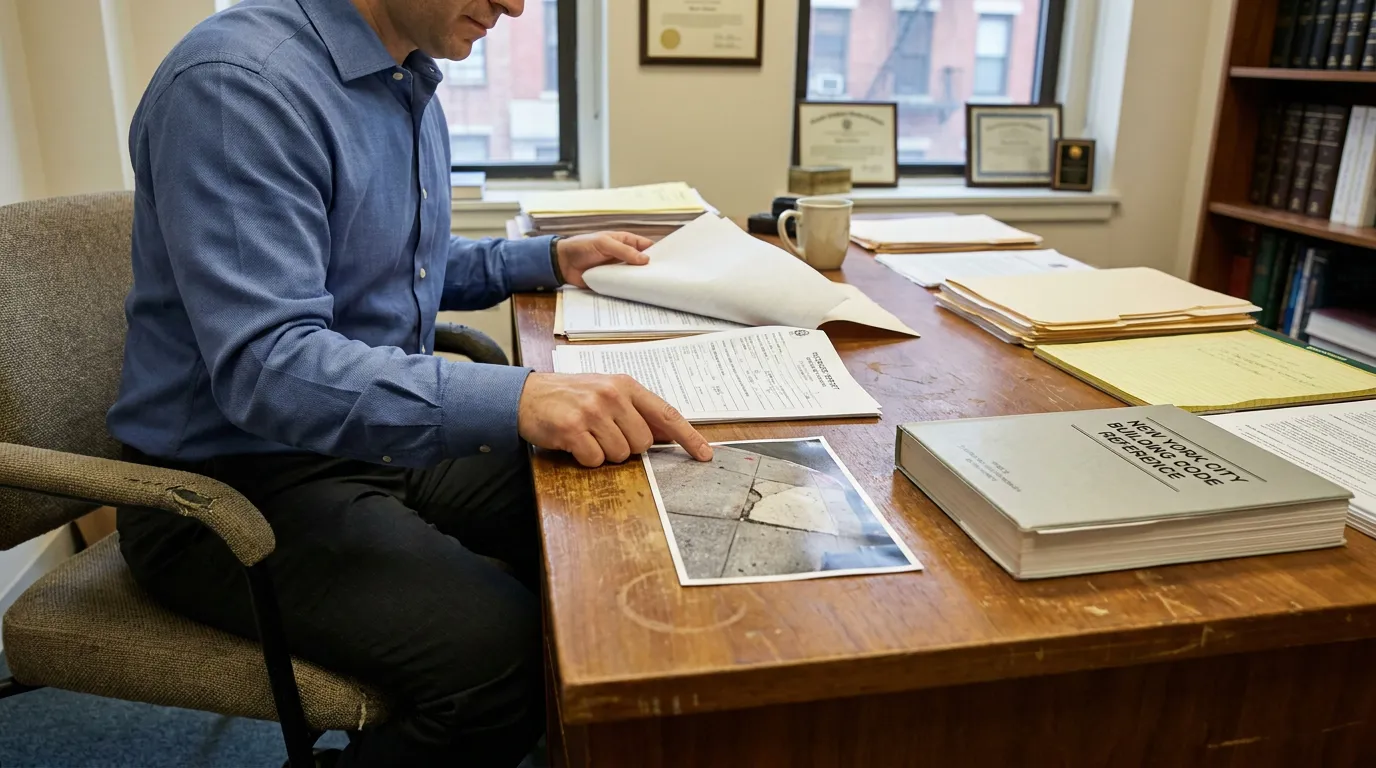
How the Trivial Defect Doctrine New York Courts Apply Actually Works
The doctrine functions as a defense within New York’s premises liability framework. To recover in a slip and fall case, a plaintiff must show that a dangerous condition existed, that the owner created it or had actual or constructive notice, and that the owner failed to correct it. The trivial defect doctrine attacks the first element by arguing that no legally significant hazard existed.
New York law places responsibility for dangerous premises conditions on those who own, occupy, or control the property. Under NY RPAPL § 778(6), an administrator may be liable for injury "by reason of conditions of the premises in a case where an owner would have been liable." In New York City, Administrative Code § 7-210 shifts sidewalk maintenance liability to the abutting property owner, with exceptions for owner-occupied one-, two-, and three-family residential properties used exclusively for residential purposes.
Why Measurement Alone Rarely Decides the Case
Defendants often lead with a number, hoping a court will treat a fraction of an inch as dispositive. New York appellate courts, including the Court of Appeals in Hutchinson v. Sheridan Hill House Corp., have declined to adopt a bright-line minimum height differential. A defect that is jagged, debris-filled, shadowed, or located where pedestrians are distracted may be actionable even when measuring under an inch.
The "Trap or Snare" Concept
Courts frequently ask whether the condition had trap or snare characteristics. A shallow but wide depression that collects rainwater, a chipped edge that catches a shoe, or a color-matched elevation change that is nearly invisible can all support an argument that the defect was more dangerous than its dimensions suggest. This is why prompt photographs matter in a nyc sidewalk defect case.
💡 Pro Tip: Photograph the defect from multiple angles with a coin, ruler, or credit card placed beside it, and capture wide shots showing lighting and surrounding pedestrian traffic on the same day if possible.
Sidewalk Falls, Municipal Property, and Prior Written Notice
A defect can be substantial and still produce no recovery if a procedural notice requirement was not met. When a fall occurs on a public walkway maintained by a municipality that has enacted a prior written notice law, New York law may bar the claim absent prior written notice of the condition, subject to exceptions such as where the municipality affirmatively created the defect. The village prior written notice statute provides that no civil action shall be maintained for injuries caused by a sidewalk, crosswalk, or street being defective unless written notice was given to the village clerk and the municipality failed to repair within a reasonable time.
Claims involving government agencies carry separate administrative prerequisites. Under General Municipal Law § 50-e, a Notice of Claim generally must be served within 90 days after the claim accrues, and under General Municipal Law § 50-i the lawsuit generally must be commenced within one year and 90 days. Courts may permit late service in limited circumstances, but leave must ordinarily be sought within the applicable limitations period.
Deadlines That Can Quietly End a Strong Case
In New York, a plaintiff generally has three years from the date of the accident to commence a personal injury lawsuit under CPLR § 214. This is the standard rule for slip and fall claims against private property owners.
Tolling and discovery-based extensions exist but apply only in limited circumstances. Infancy, incapacity, and certain other conditions may toll a period under CPLR § 208, but no extension should be assumed. Because the analysis is fact-sensitive, a person injured in a fall may need to act well before the outer deadline to preserve evidence and meet administrative prerequisites.
| Issue | General Rule | Practical Effect |
|---|---|---|
| Private property fall | Generally three years from the accident date (CPLR § 214) | Suit generally must be commenced within the civil period |
| Government or municipal property | Notice of Claim within 90 days under GML § 50-e; suit generally within one year and 90 days under GML § 50-i | Administrative step generally precedes the lawsuit |
| Certain municipal sidewalk defects | Prior written notice, such as under CPLR § 9804 for villages | Claim may be barred absent written notice and failure to repair, subject to exceptions |
Comparative Fault Is Not the Same as a Trivial Defect
A trivial defect finding may defeat liability outright, while comparative fault only reduces what you recover. New York codifies comparative negligence, and under CPLR § 1411, culpable conduct attributable to the claimant "shall not bar recovery." Instead, damages "shall be diminished in the proportion which the culpable conduct attributable to the claimant or decedent bears to the culpable conduct which caused the damages."
New York follows a pure comparative approach. Comparative negligence reduces the damages a plaintiff can recover according to the degree of negligence contributed, so a plaintiff found 40% at fault may recover 60% of the damages. Under the pure rule, a plaintiff may still claim damages for the 1% they are not at fault even when 99% responsible.
Other Defenses You May Encounter
Trivial defect arguments rarely travel alone. Insurers often pair them with notice challenges, open-and-obvious arguments, and the storm in progress doctrine, under which a property owner is not required to remedy a snow or ice condition until a reasonable time after an active storm ends. In New York, an open and obvious condition does not eliminate a duty to maintain the property; it typically bears on comparative fault. Understanding the top defenses in slip and fall claims may help anticipate what is coming.
- Photographs and video of the defect taken before any repair
- Measurements documenting depth, width, and elevation change
- Weather records and lighting conditions at the time of the fall
- Witness names and contact information
- Maintenance logs, inspection records, and prior complaint history
- Medical records connecting your injuries to the incident
💡 Pro Tip: Send a preservation letter requesting surveillance footage promptly, because many NYC buildings and businesses overwrite recordings within days or weeks.
What Injured New Yorkers Can Do to Strengthen a Claim
Documentation created in the first hours after a fall can influence whether a defect looks trivial or dangerous months later. Repairs happen, seasons change, and a hazard that trapped your heel in February may be repaved by spring. Seeking prompt medical evaluation also matters, particularly with head, neck, and fracture injuries where symptoms can be delayed.
Because outcomes depend heavily on the specific facts of each fall, general rules cannot predict any particular result. A trip and fall lawyer reviewing your matter will evaluate the defect’s characteristics, the owner’s notice, the applicable deadlines, and whether municipal notice rules apply. If you were hurt by what someone called a minor imperfection, a trivial defect doctrine New York lawyer can assess whether the condition may be actionable.
Frequently Asked Questions
1. Is there a minimum height difference that makes a sidewalk defect actionable in New York?
No fixed measurement controls the analysis. New York courts reject bright-line rules and instead review the defect’s dimensions along with its shape, surroundings, lighting, and circumstances. A small elevation change may still be actionable, while in other cases a small defect may be held trivial as a matter of law.
2. Can I still recover if I was partly at fault for my fall?
Potentially. Under CPLR § 1411, contributory negligence and assumption of risk do not bar recovery in New York, though damages may be reduced in proportion to your share of fault.
3. How long do I have to file a slip and fall lawsuit in New York?
A personal injury claim against a private property owner must be commenced within three years of the accident. Claims involving government entities require a Notice of Claim within 90 days and suit within one year and 90 days.
4. Does the trivial defect doctrine apply to indoor falls too?
It can. While the defense arises most often in sidewalk injury NYC matters, owners also raise it for minor floor irregularities, small threshold elevations, and shallow stair variations. The same fact-specific analysis applies.
5. What if the property owner repaired the defect after my fall?
Prompt repair does not automatically establish liability, and evidence of subsequent repairs is generally inadmissible to prove negligence. Once a condition is fixed, proving its original dimensions becomes harder. Photographs, witness accounts, and prior complaint records may become the primary evidence.
Protecting Your Claim When an Insurer Says the Hazard Was Too Small
The trivial defect doctrine gives property owners a genuine defense, yet it may be far narrower than insurance adjusters suggest. New York courts weigh the full context of a fall rather than a single measurement, and doctrines like comparative negligence, prior written notice, and applicable filing deadlines each play separate roles.
If you were injured on a sidewalk, stairway, or floor in New York City, timing and evidence may be working against you right now. Reach out to Pianko Law for a discussion of your options, call (646) 801-9675, or schedule your consultation today.
Disclaimer: This content is for informational purposes only and is not legal advice. Every case is unique, and results may vary. Consult an attorney about your specific circumstances.